
Promise 7, 8 and 9 of 15
Oopbuy's Delivery Guarantee and More protection, read against the insurance terms
Two badges on the homepage strip speak about protection. One maps to a compensation clause with deadlines and exclusions. The other leads to a page that holds one sentence. A third promise, on the purpose page, gives a delivery time.
Delivery Guarantee and the compensation clause
Matching clause, with limits
The promise
Delivery Guarantee
Homepage, "Why Choose Oopbuy?" strip
The clause
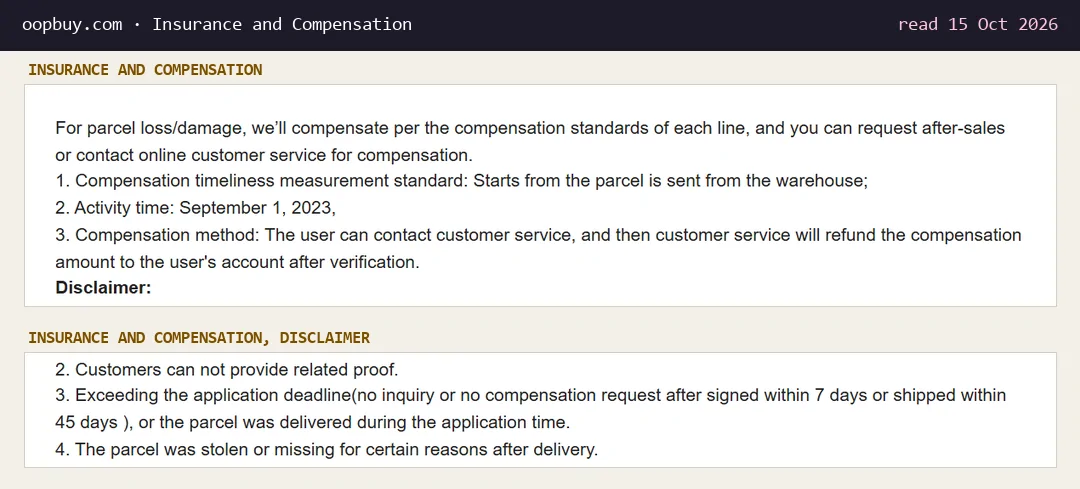
For parcel loss/damage, we'll compensate per the compensation standards of each line, and you can request after-sales or contact online customer service for compensation.
Insurance and Compensation, read 15 Oct 2026
Between the two
- Compensation is per route: each shipping line has its own standard, and separate articles cover insured and uninsured parcels.
- Oopbuy measures compensation timeliness from the moment the parcel leaves the warehouse.
- Payment goes to your Oopbuy account after customer service verifies the claim.
- No claim after 7 days from signed delivery or 45 days from dispatch.
"Delivery Guarantee" is the shortest of the badges and the insurance page is the clause that answers it most directly. It does not promise delivery; it promises compensation, on terms set route by route. Those are different things, and the gap between them is the deadline and the exclusion list.
The estimator marks routes with "Insurance Available". That label tells you insurance can be bought on the route, not that a parcel on it is covered by default. The compensation standards for insured and uninsured parcels are in two separate help articles.
The seven exclusions
The disclaimer under the insurance clause lists seven situations where compensation does not apply. Read them as the outer edge of the Delivery Guarantee.
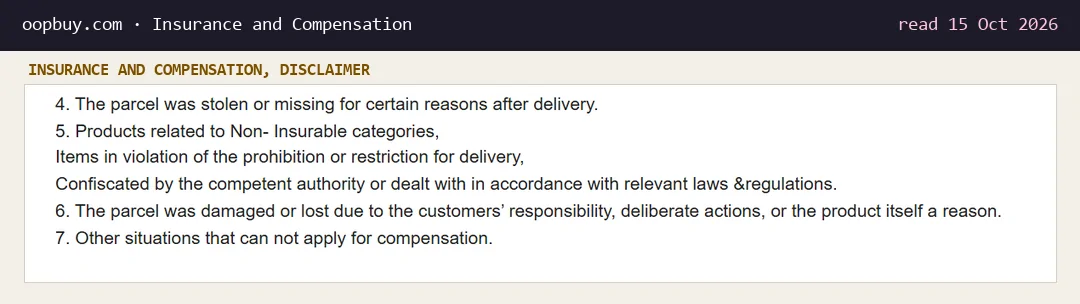
Force majeure; no proof; a claim after the 7-day or 45-day deadline; a parcel stolen or missing after delivery; non-insurable categories, prohibited items and goods confiscated by an authority; damage or loss caused by the customer or by the product itself; and "other situations that can not apply for compensation". The last one is open-ended, which means the list is not complete by its own wording.
More protection, and the page behind the name
No matching clause found
The promise
More protection
Homepage, "Why Choose Oopbuy?" strip
The clause
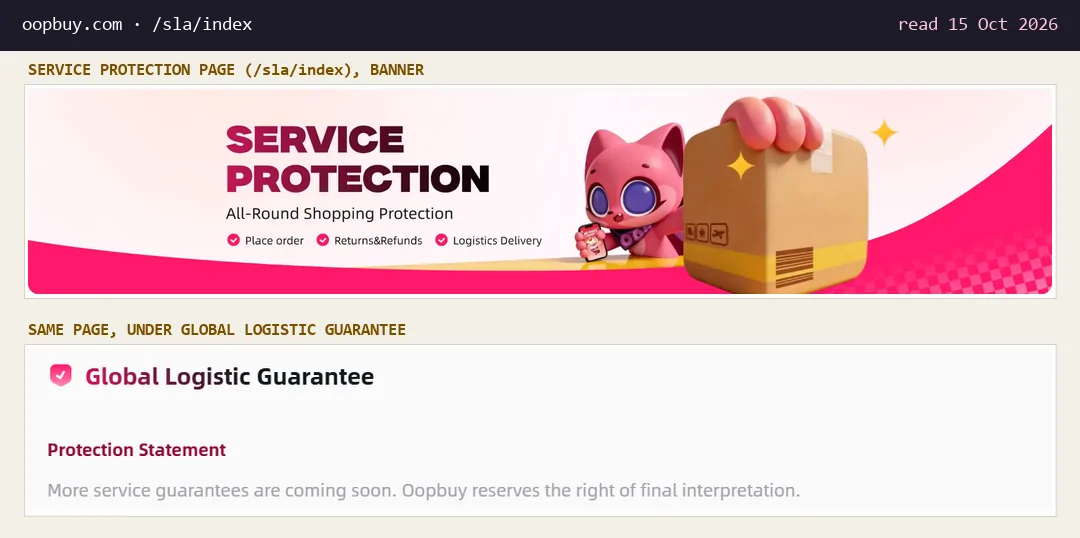
Under the heading Global Logistic Guarantee, the Service Protection page holds one line: a statement that further service guarantees will be added later, and that Oopbuy keeps the right of final interpretation.
oopbuy.com/sla/index, read 15 Oct 2026
Between the two
- The page banner reads Service Protection, All-Round Shopping Protection, with three ticks: Place order, Returns&Refunds, Logistics Delivery.
- Below it there are no terms, limits or amounts.
- When we opened the page without an account, a sign-in prompt covered it first.
- None of the homepage badges was a link in the page markup we captured.
The Service Protection page is the only page on oopbuy.com whose title matches the protection badges. Its banner names three areas of protection; its content section has a single statement and no terms. That is why More protection carries No matching clause found: the page exists, but it does not yet say what the protection is.
"Final interpretation" is a phrase common in promotional terms in China. It reserves to the operator the right to decide what its own wording means. Read beside an empty protection statement, it leaves the existing clauses, insurance and returns, as the written standard you can point to.
Seven working days at the earliest
Matching clause, with limits
The promise
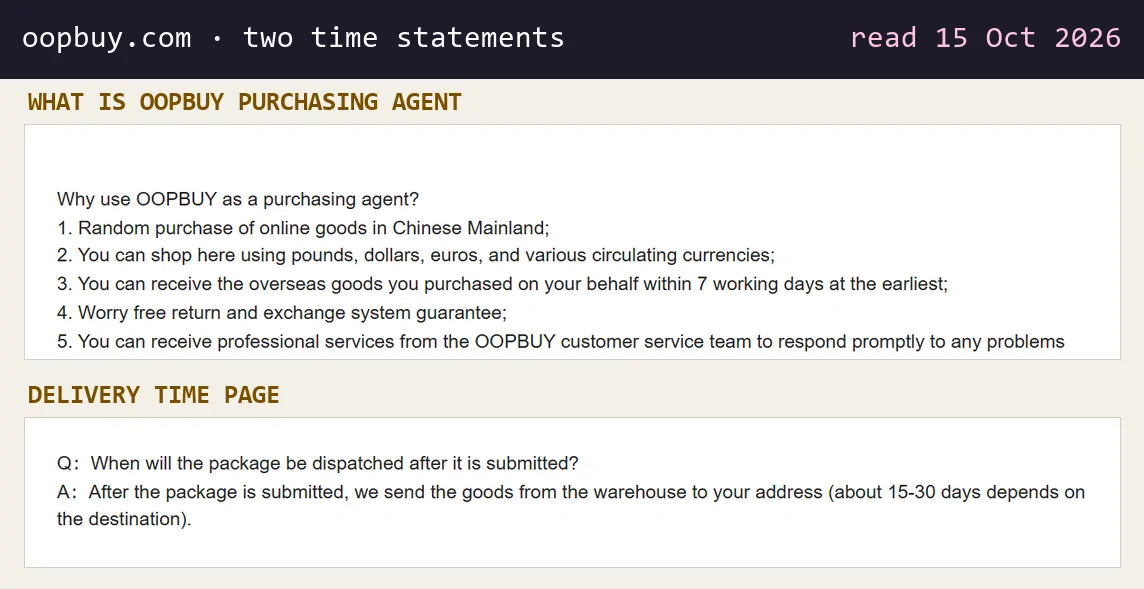
You can receive the overseas goods you purchased on your behalf within 7 working days at the earliest
What is OOPBUY purchasing agent?, read 15 Oct 2026
The clause
After the package is submitted, we send the goods from the warehouse to your address (about 15-30 days depends on the destination).
Delivery Time page, read 15 Oct 2026
Between the two
- "At the earliest" marks the first figure as a lower bound, not a typical time.
- The Delivery Time page gives a range for most destinations.
- The live estimator gives route-specific times. On 10 October 2026, for a 1 kg US parcel, the fastest route listed 7 to 12 working days and the cheapest 15 to 20.
- None of these figures includes the time before the parcel is submitted: seller shipping, domestic transit and your own decision.
These three time statements do not contradict each other. They describe different things: a best case, a typical range and a per-route quote. The trouble comes only if you read the best case as a promise for your parcel.
Use the estimator figure for the route you pick, and add the steps before submission. A realistic plan from payment to door is the seller's 3 to 7 days, domestic transit, your storage time, then the route time.
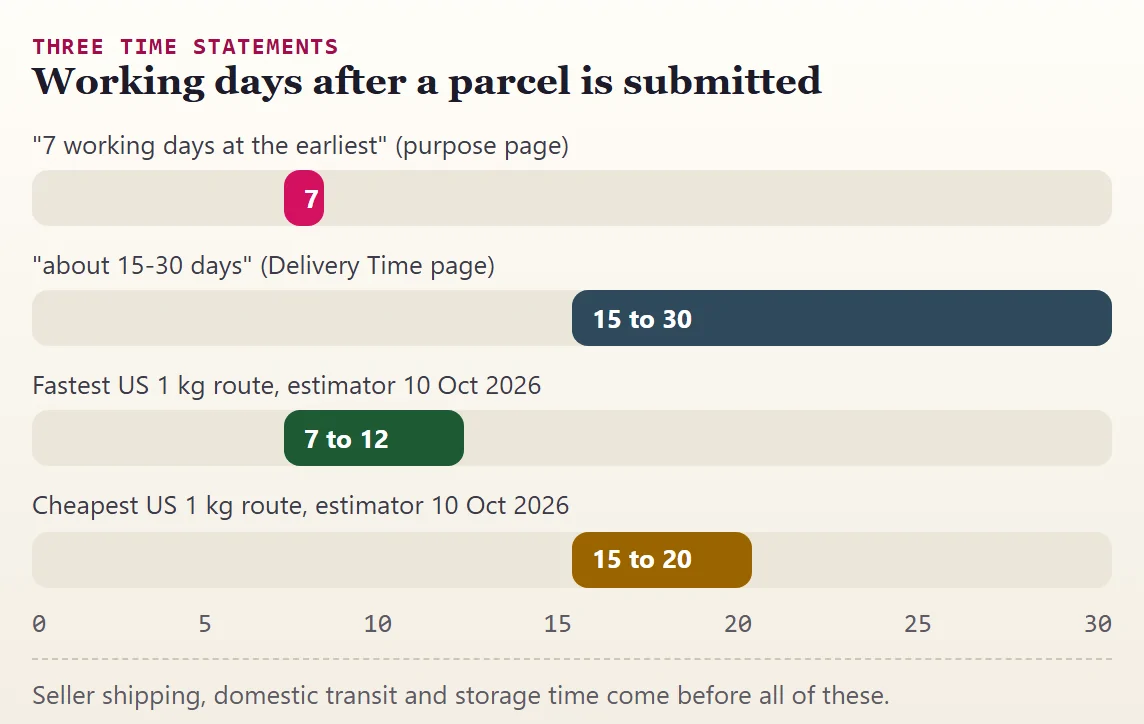
The chart puts the three statements on one scale. The first figure sits at the very left; the help page range stretches across the middle; the two estimator routes for a US 1 kg parcel sit inside it.
Route prices and times change. The estimator figures here are dated 10 October 2026 and will move. Run the estimator yourself before choosing.
Shipping and the parts no agent controls
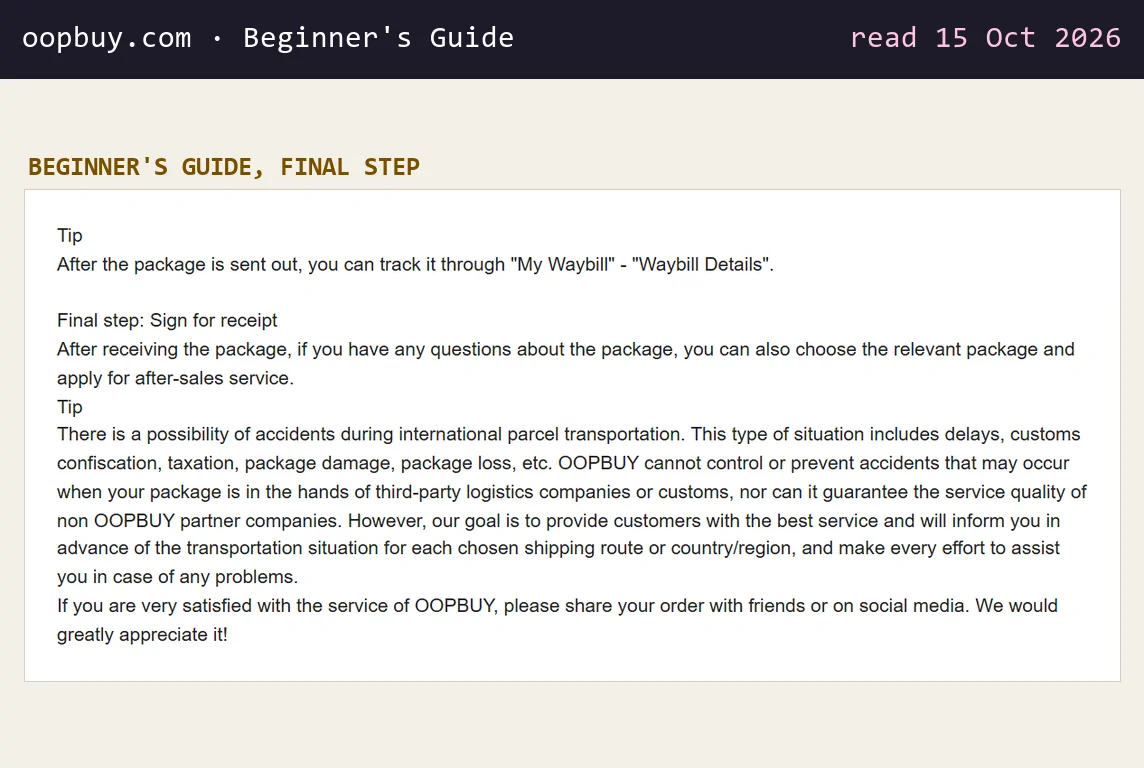
The final tip in the Beginner's Guide is blunt: delays, customs confiscation, taxation, damage and loss can happen while a parcel is with third-party carriers or customs, and Oopbuy cannot control or prevent them, nor guarantee the service of companies that are not its partners.
The first-order help article says the same in other words: the logistics are provided by third parties, customs rules apply, and the risks are yours to consider. Read alongside the Delivery Guarantee badge, these texts mark where the agent's part of the journey ends.
What remains on Oopbuy's side is advance warning about a route's risks and help if something goes wrong, which both texts mention, and the compensation clause with its deadlines.
Choosing a shipping line with the promise in mind
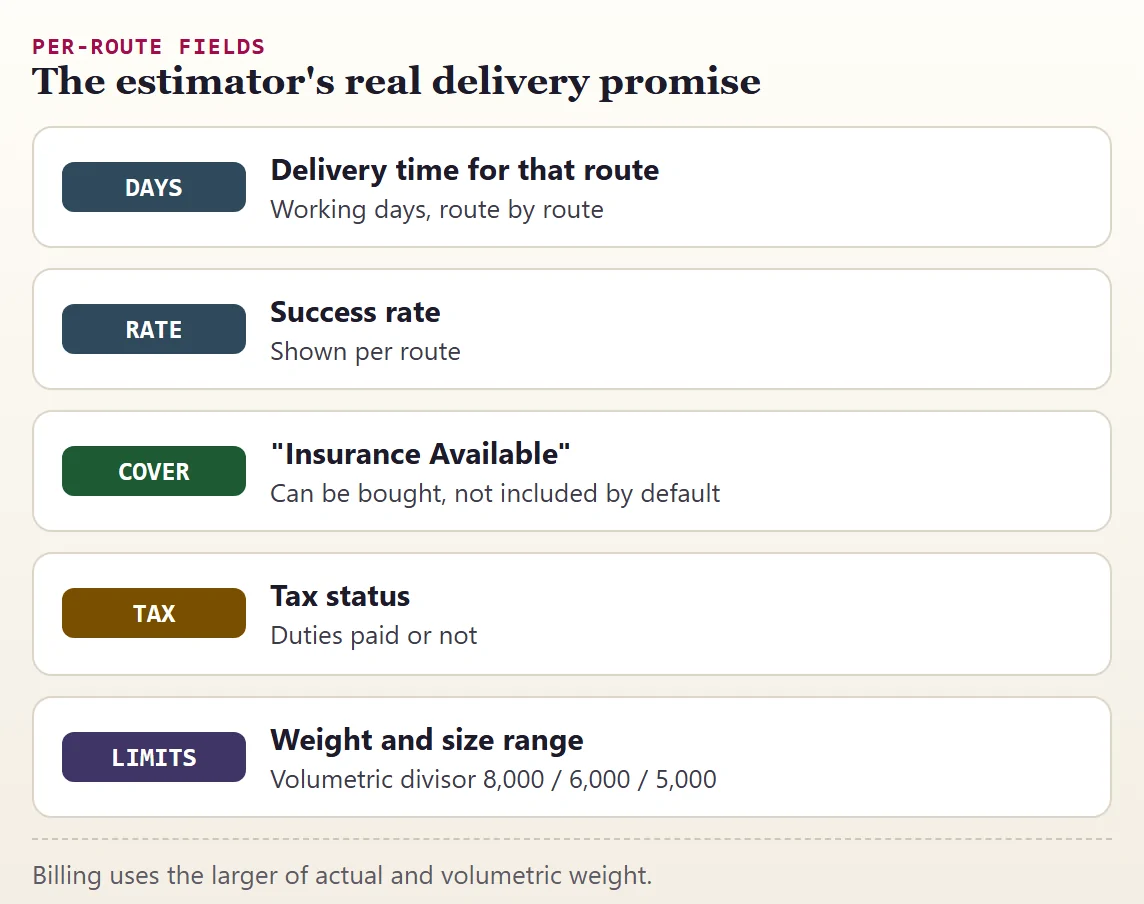
Every route in the estimator shows its delivery days, a success rate, whether insurance is available, its tax status and its weight and size limits. Those fields help compare routes, but estimates and displayed statistics are not guaranteed outcomes for an individual parcel.
Where a route uses dimensional billing, it may use the larger of actual and volumetric weight; verify the chosen line’s rules. Volumetric weight is length times width times height in centimetres divided by a route coefficient of 8,000, 6,000 or 5,000, according to the help centre. A light, bulky jacket can cost more than a heavy pair of jeans.
If a parcel matters, buy the insurance where the route offers it, keep unboxing photos, and put a reminder in your calendar for day 6 after delivery. The 7-day deadline is short, and the exclusion for missing proof is the easiest one to fall into.
Choose a parcel plan before the second payment
Check the destination and goods type first. Perfume, batteries and other restricted goods may have fewer eligible routes. Do not assume items can travel together merely because they can be stored together.
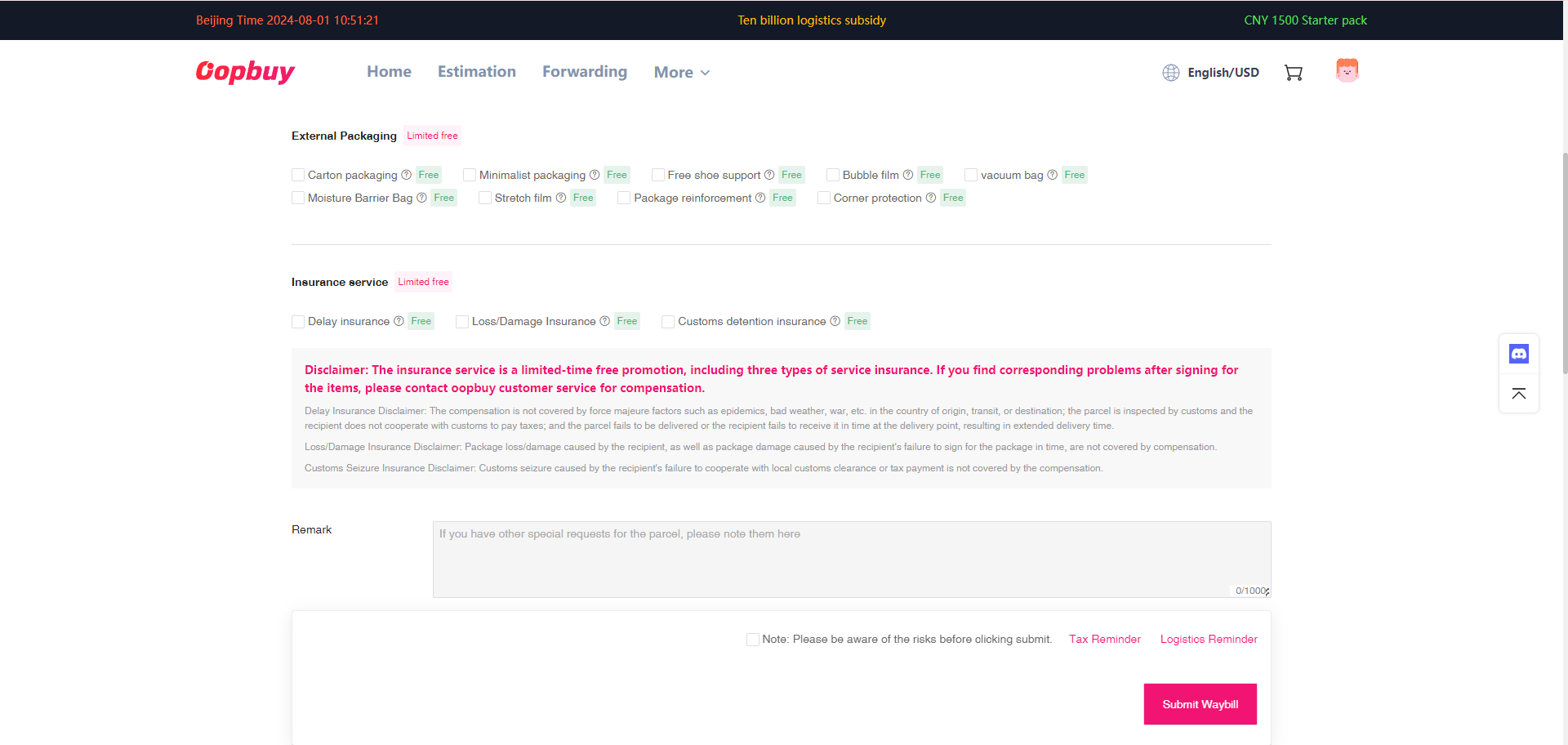
Pack for the item, then compare routes
Ask what protective packing is needed and what removing a box would change. Keep packaging if it is needed for protection or a pending return. Compare the route’s chargeable weight rule, size limit, tracking, claim terms and total price. Some routes use dimensional weight; check the specific calculation rather than assuming every line uses the same divisor.
Track, receive and keep evidence
Save the parcel number and final payment record. If tracking has no scan, compare it with the stated handling time, then ask support. At delivery, photograph damaged packaging, retain labels and record opening. Contact account support promptly with the order and parcel IDs, photos and the requested remedy; route-specific claim windows can be short.
For a customs request, use the carrier’s verified channel and accurate documents. Taxes, clearance and delivery schedules depend on destination and route. A historic delivery range or a protection badge is not a guarantee for your parcel.